
MILESTONES
17 May 2018
Strategic Action Plan for Batteries
A Strategic Action Plan for Batteries that supports the measures proposed by the EBA@250 stakeholders was published as part of the Clean Mobility Package in May 2018. The Clean Mobility Package is a set of initiatives initiated by the European Commission to allow all Europeans to benefit from safer traffic, less polluting vehicles and more advanced technological solutions, while supporting the competitiveness of the EU industry.
23 February 2018
EU Industry Day
18 high priority actions resulting from the EBA@250 stakeholder consultation process were presented at Clean Energy Industrial Forum, during the European Industry Day in February 2018.The EU Industry Day is a forum for key industrial players and EU political leaders and policy makers where to discuss on a joint vision for the long-term future of European industry.
11 October 2017
Launch of the European Battery Alliance
The European Battery Alliance (EBA) was officially launched in October 2017 by Vice President Šefčovič with the aim to create a competitive manufacturing value chain in Europe with sustainable battery cells at its core.
THE VALUE CHAIN APPROACH
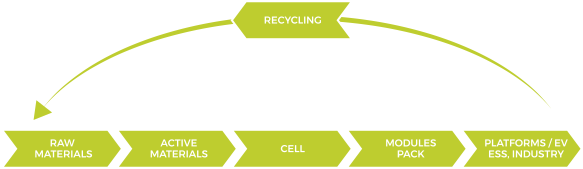
The value chain approach is usually not the norm in mature industries. However, for fast developing new industries this approach is essential.
To acquire the batteries needed, you have to ensure that the batteries are being manufactured. For this, battery cells must be produced. Raw materials must be made available. And finally, for the market to accept your product – you must have a recycling process in place.
The goal of the European Battery Alliance is to ensure an unbroken value chain in Europe that can supply the market with all it needs, with the lowest environmental footprint possible.
Make Europe the global leader in sustainable battery technology:
Create and support new markets for batteries, e.g through the “Clean Energy” & the “Mobility” packages but also new initiatives, in order to support sustainable solutions for power, transportation and industry sectors in line with EU climate goals.
Involve (= inform, educate & motivate) the EU citizens in the journey.
OUR STAKEHOLDERS
The European Battery Alliance is made up of a number of organisations from both the public and private sector. All in all more than 120 entities work together.
RAW MATERIALS
- Boliden
- EUROMINES
- Eramet
- Leading Edge Materials
- Magnis /Allocate
- Outotec
- Rio Tinto
- Terrafame
ACTIVE MATERIALS
- Arkema
- BASF
- BELENOS
- Blue Solutions (Bolloré)
- CEFIC
- Heraeus
- Nanomakers
- NXP Semiconductors
- SGL Carbon SE
BATTERY CELLS & BATTERY PACKS
- Akasol
- BMZ - Batteriemontagezentrum
- Continental
- CustomCells
- E4V
- EAS Batteries
- EoCell Inc
- HE3DA
- KLIB
- Leclanché
- Liacon
- LION E-Mobility
- Litarion GmbH
- Northvolt
- Saft
- Sonnen GmbH
- Terra E
- Varta
APPLICATIONS
- Atlas Copco
- BMW
- cyberGRID GmbH
- Daimler
- Edf
- Elring-Klinger
- Enel
- Fiat
- Husqvarna
- Jaguar-Landrover
- Manz
- Nissan (FR)
- PSA Groupe
- Renault
- Stihl
- Terna
- Total
- Vattenfall
- Volkswagen
- Volvo
RECYCLING / 2ND LIFE
- EBRA
- Solvay
- SUEZ
- Umicore
- Veolia
RESEARCH ORGANISATIONS & ASSOCIATIONS
- Akkurate OY
- ANIE
- Ångström Advanced Battery Centre
- CEA
- CEPS
- E4V
- EASE
- EIT Raw Materials
- EMIRI
- ENEA
- EUROBAT
- Fraunhofer
- RECHARGE
- SET Plan TWG 7
- T&E (Transport and Environment)
OTHER BATTERY INITIATIVES
 The Batstorm project supports the European Commission and the European Technology and Innovation Platform (ETIP) for Smart Grids and Storage in their progress to identify and support RTD&D needs and market uptake of battery based energy storage as one low-carbon technology of the future energy system.
For more information, contact:
Ilka von Dalwigk
Policy Manager, InnoEnergy
ilka.vondalwigk@innoenergy.com